- Feedback
- About
- Certificates
- Clientele
- Installations
- Testimonials
- Contact
- Career
- Get Quote


Flame Detector: UV vs IR vs UV/IR Types, Range & Approvals Guide

Saeed Lanjekar
20 Nov, 2026
7 Minutes
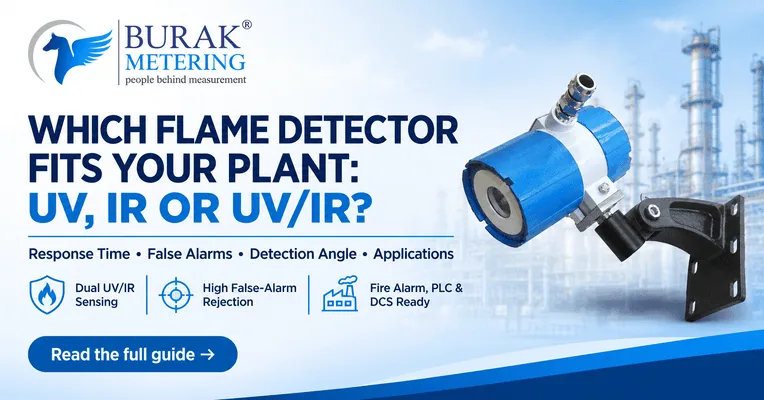
A flame detector is a safety detector that works to sense the radiation that fire gives off, and sounds an alarm within seconds. This type of detector works to identify the radiation that the flame gives off, as opposed to smoke or heat, and works well in open, ventilated plants, where a smoke detector may work well.
There are three main technologies:
UV (ultraviolet): reacts to the ultraviolet light of a flame.
IR (infrared): reads the infrared signature of a fire, usually with three sensors (IR3).
UV/IR: needs both signals to agree before it raises an alarm.
Let's break each one down, minus the jargon headache.
Quick takeaways:
Consider the fuel you are monitoring and the false alarm sources.
Check if the detector is certified (ATEX, IECEx, PESO) before you shortlist.
Pair fire detection with gas detection for complete protection.
Ask for range data by fuel, not just one number.
What Is a Flame Detector and How Does It Work?
A flame detector is a type of safety detector, that works to sense radiation, in a given area, that a flame gives off. When this pattern is identified, an alarm is triggered.
Think of it like a focused security camera. It looks for a pattern, and not faces.
Here is what happens inside a typical flame sensor:
The optics collect radiation from the monitored zone.
The electronics compare it against fire signatures.
The logic rejects sunlight, welding and hot machinery.
The detector raises an alarm, or shuts down equipment through your control system.
Most plants connect these units to a wider fire and gas detection system, so one alarm can trigger sirens, shutdowns and deluge.
Why Choose a Flame Detector Over Smoke or Heat Detection?
A flame detector is useful in places where smoke and heat sensors are of no help. This is especially the case outdoors, in the case of tall buildings, or with respect to fast burning fuels.
Speed: one manufacturer reports a 5 ms response to a fast fire burst on its UV/IR model.
Open-air coverage: smoke drifts away in a breeze, but optics keep watching the source.
Tested rejection: FM 3260 expects a flame detector to ignore sunlight, arc welding and heaters while still catching a test fire.
Wide view: heat sensors wait for hot air to reach them, while optics see the flame directly.
UV vs IR vs UV/IR Flame Detectors: Which Is Better?
There is no single winner. The best choice depends on your fuel, your site and your false-alarm risks.
Feature | UV | IR / IR3 (triple IR) | UV/IR |
|---|---|---|---|
What it senses | Ultraviolet radiation | Infrared bands, compared against each other | UV and IR together |
Response time | Very fast (milliseconds) | Fast; one manufacturer lists 4.1 s at 70 m for IR3 | 1 s at 15 m, under 2 s at 30 m (one manufacturer's IR3 vs UV/IR data) |
Typical range (1 ft² heptane pan) | Short to medium | Up to 80 m for IR3 | About 30 m |
Main false-alarm sources | Arc welding, lightning, corona | Hot objects, nearby flares, exhaust, blocked view | Electrical arcs, welding, corona |
Best for | Fast reaction in clean areas | Hydrocarbon fires, long range | Mixed fuels, including hydrogen |
Relative cost | Lower | Medium to higher | Medium |
Cost is a relative guide only. Prices vary by brand, approvals and housing material.
Why does a UV/IR flame detector reduce false alarms?
Because they use two independent checks. A welding arc may fool the UV channel, but the IR channel stays quiet, so no alarm.
That is why many EHS teams pick UV/IR for general plant use. It is also a common choice for the flame sensor in mixed-fuel areas.
When is an IR3 detector the smarter pick?
Choose IR3 when you need long range for hydrocarbon fires. One manufacturer rates its IR3 model at 80 m for a 1 ft² n-heptane pan fire, against about 30 m for its UV/IR model.
The catch? IR3 isn't suited to non-hydrocarbon fires. If hydrogen or metal fires are on your risk list, UV/IR is usually the safer route.
What do the numbers mean in real life?
Range depends on the fire size and fuel. Always check the rating against the smallest fire you must catch.
Response time changes with distance. A fire at 70 m takes longer to confirm than one at 15 m.
Field of view matters. Under FM 3260, a detector must respond at 50% or more of its on-axis sensitivity in four directions.
What Mistakes Should Buyers Avoid?
Most bad purchases come from rushing the datasheet. These are the traps we see most often:
Buying on range alone. An industrial flame detector with a long-range figure means little if your smallest credible fire is far smaller than the test pan.
Ignoring line of sight. Optical units need a clear view, so pipes, tanks and scaffolding create blind spots.
Treating every safety detector as equal. A basic industrial safety detector without hazardous-area approval has no place in a classified zone, however cheap.
Forgetting the gas side. A solid setup pairs industrial gas leak detection with flame detection.
Skipping upkeep. A dirty window cuts sensitivity, so plan cleaning and function checks from day one.
How Are Flame Detectors Certified for Hazardous Areas?
Flame detectors used in hazardous areas require two proofs. Firstly, they need to function as a fire detector. Secondly, they can’t be an ignition source. The first proof is covered by standards such as FM 3260. The second proof is covered by Directives such as ATEX, IECEx, and PESO, in India.
This is how the puzzle fits together:
- FM 3260: FM Approvals’ standard for approving radiant energy-sensing fire detectors. FM 3260 standard defines tests detectors should withstand, and states alarms should be generated within 30 seconds from the start of a 12 x 12 inch n-heptane pan fire. The standard also covers detectors’ immunity to stimuli such as arc welding and ultraviolet (UV) lights.
- ATEX: The European framework for equipment used in explosive atmospheres.
- IECEx: International scheme based on IEC 60079 series.
- PESO: India’s Petroleum and Explosives Safety Organisation which approves Ex electrical apparatus used in hazardous areas of the country.
What does PESO ask for in India?
According to PESO’s published procedure, test evidence from an IECEx recognized lab, or an IECEx Certificate of Conformity with test reports and drawings is required. PESO also lists protection type “d” (IEC 60079-1) in the protection types approved by it.
For imported equipment, expect extra paperwork:
Proof of your Indian agent
An authorization letter from the manufacturer
A service agreement covering spares, repair and commissioning
PESO states that an approval stays valid until the product standard or product design changes. Thus it would be prudent to assume the EU Type Examination certificate (the ATEX route) is only valid for imports from European manufacturers. Any industrial flame detector imported to India needs this documentation. Ask your supplier to provide these documents.
Where Is a Flame Detector Used in Industry?
The areas at risk of a fire incident are normally at the site of process equipment and or machinery. From a flame detection perspective, these areas are covered in a similar manner as a gas detection system. A comprehensive design of a flame detection system covers the areas where a fire is most likely to occur.
Oil and gas
Refineries, compressor stations and loading racks (tank farms) all have equipment that handles flammable liquids and gases. All industrial flame detectors in this segment face severe service conditions. IR3 flame detectors have a special mode to ignore engine exhaust at a loading bay in a tanker loading rack.
Power plants
Fires are of a concern in fuel storage, switchyards and turbine halls. UV/IR flame detectors can sense sparks and arcs and are therefore suitable for electrical installations (HVDC).
Chemical storage
Burn characteristics of solvents, hydrogen and mixed chemicals are different. One UV/IR datasheet lists 20m hydrogen detection limit, while IR3 models are designed to detect hydrocarbon fuels, thus the detector should be matched to the chemical.
Warehouses and hangars
Smoke in high ceilings warehouse and hangars means a widely scanned field-of-view flame detector can monitor racks and loading bays, and detect a fire in an aircraft hangar.
Flame Detector vs Gas Detector: Do You Need Both?
In most of the hazardous plants, you need both. A gas detector alarms you of a potential fire, a flame detector confirms it. One is your smoke detector for leaks and the other is your fire detector.
Here is the simple split:
Gas leak detection system: catches leak early, measured as a percentage of the lower explosive limit (LEL).
Flame detection system for industrial safety: catches ignition and fire, even outdoors.
Industrial gas monitoring system: tracks gas levels around the clock across the site.
Combined fire and gas safety system: links both, so the plant responds as one.
There's an interesting fact. An infrared gas detector cannot detect hydrogen, however a UV/IR unit can see a hydrogen fire. Thus, a gas and flame detector combination makes sense in industries that handle mixed hazards.
Want to understand the gas side first? Here's an optional read on how to choose an infrared gas detector for methane, propane and LPG leaks.
How Should You Place and Maintain Your Detectors?
Good placement matters as much as good hardware. Even the best flame sensor can't detect what it can't see.
Map the hazards first. Walk the site with your EHS lead and the installer, then mark leak points, pumps, flanges and storage, then cover them with overlapping fields of view.
Think about blockage. Pipe racks, tanks and temporary scaffolding can hide a fire from the optics.
Mind the sun and heat. Avoid aiming at reflective surfaces or hot exhausts where you can.
Test regularly. Follow the manufacturer's manual and your site's safety study for function checks and window cleaning.
For plants that run around the clock, this routine is cheap insurance. It keeps your whole setup ready on the day you need it.
How Do You Choose the Right Flame Detection System?
Start with your fuel and your site, not the brochure. This quick checklist keeps buying decisions clean:
Fuel type: hydrocarbon only, or hydrogen and metals too? Ask for range figures per fuel.
Environment: welding, flares, exhaust, sunlight or dust nearby?
Distance: what is the farthest point you need to cover?
Certification: ATEX, IECEx or PESO for your zone and country.
Self-test: built-in optical checks reduce manual test rounds, a feature one manufacturer highlights for its units.
Supplier support: a reliable safety detector supplier should offer spares, commissioning and after-sales service.
Integration: relay, 4-20 mA or HART outputs so the flame detection system talks to your gas monitors.
Frequently Asked Questions
What is the difference between UV and IR flame detectors?
The difference is in the technology. An ultraviolet (UV) flame detector reacts to ultraviolet radiation whereas, an infrared (IR) flame detector reacts to the infrared radiation signatures of a flame.
How far can a flame detector see?
The distance a flame detector can sense a flame, as with all technologies, depends on the manufacturers' claims.
Can a flame detector detect a hydrogen flame?
Yes, UV/IR models can detect a hydrogen flame.
Is a flame detector the same as a smoke detector?
No, as a flame detector reacts to the radiation of the flame itself, and a smoke detector reacts to the presence of smoke in the air.
What causes false alarms in a flame sensor?
Falls are the most common cause, but flares and hot objects can also cause alarms. Using UV/IR and IR3 logic helps to filter out the effect of falls.
Does a flame detector require PESO approval in India?
Yes, for equipment to be used in a hazardous area of India, the Ex approval is generally required from PESO, and you must confirm the certificate with your supplier prior to purchase.
Get the Right Flame Detector for Your Plant
Need a certified industrial flame detector or a full gas and flame detection system? Talk to Burak's safety team for the right fit.
Share this post


I’m Saeed Lanjekar, founder of Burak Metering. With a background in engineering and technology, I’ve dedicated my career to creating advanced metering solutions that push the boundaries of accuracy and efficiency. At Burak Metering, we’re committed to delivering top-notch technology and driving innovation in the metering industry.
Products
Infrared Gas Detector
Infrared Gas Detector
An infrared gas detector is a device used to detect the presence of gases in an area, often as part of a safety system. These detectors can be portab…
Learn More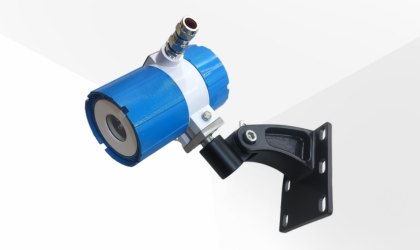
Flame Detector
Flame Detector
A flame detector is a specialized sensor designed to detect the presence of an open flame by analyzing the radiation emitted during combustion. It pl…
Learn MoreModels
Related Blogs

 Email
 WhatsApp
 Phone
Newsletter
Subscribe to our newsletter for updates!

