- Feedback
- About
- Certificates
- Clientele
- Installations
- Testimonials
- Contact
- Career
- Get Quote


How to Choose an Infrared Gas Detector for Methane, Propane & LPG Leaks

Saeed Lanjekar
22 Oct, 2026
7 Minutes
A gas leak doesn’t knock before entering a house. There is no color, very often there is no smell, and there is absolutely no warning. Gas is naturally odorless. And “smell of gas” is actually caused by the additive to it. Therefore, plants rely on instruments rather than on smell.
An infrared gas detector is one of the most reliable instruments for this purpose, especially for hydrocarbons. In this guide we will consider what it is, when and where it is better than other detectors, and how to purchase and maintain it.
What Is an Infrared Gas Detector, and What Does NDIR Mean?
Infrared gas detector estimates the amount of gas based on how much infrared light is absorbed by this gas. The acronym NDIR stands for non-dispersive infrared technology that is used in most fixed detectors.
According to the Beer-Lambert law, the signal intensity depends on the amount of the gas along the beam path. Nothing burns, and no chemical reaction is needed.
You will meet the same technology under several names:
- IR gas detector or infrared gas sensor
- NDIR gas detector or NDIR gas sensor
- Infrared hydrocarbon gas detector, tuned for hydrocarbon gases
- Fixed gas detector, mounted for continuous duty
How Does NDIR Infrared Gas Detection Work?
The principle of an NDIR sensor is to send infrared radiation through a gas-filled chamber and analyze two different wavelengths; one of them will be absorbed by the gas while the other won't.
Here is the sequence inside the housing:
- Source: An infrared lamp emits light across a sample chamber.
- Gas entry: Ambient gas diffuses into the chamber through a protected inlet.
- Optical filters: Fixed filters pass the measuring and reference wavelengths. There is no prism, which is what "non-dispersive" means.
- Detection: The detector reads how much of each beam arrives.
- Processing: Electronics compare the two and convert the ratio to %LEL or % volume.
- Outputs: The signal is sent to a display, PLC, or control room, and alarms operate on your set point levels.
Each gas has an absorption range. CO₂ has an absorption range of about 4.26 µm, while hydrocarbons have an absorption range of 3.3 to 3.4 µm.
The reference beam is the quiet hero. It lets the electronics ignore dirt and lamp ageing, so the reading stays honest.
Why Does an Infrared Hydrocarbon Gas Detector Excel at Methane, Propane, and LPG?
Hydrocarbons share a carbon-hydrogen bond, and that bond absorbs infrared light around 3.3 to 3.4 micrometers. An infrared hydrocarbon gas detector targets exactly this window, so one hydrocarbon gas sensor can cover a whole family of gases.
LPG is predominantly propane and butane, thus fitting into that category of gases. Natural gas, being mainly methane, also does.
Three practical points matter:
- Response differs by gas. An NDIR sensor responds more strongly to pentane than to methane. For natural gas, use the methane scale and calibrate with methane.
- Heavier vapors are manageable. Intrinsically safe NDIR designs can avoid the external flame arrestors that slow large molecules entering a sensor.
- It works in real time. The sensor reads light, not combustion, so you get real-time gas detection and continuous gas monitoring.
One more safety bonus: if the lamp or detector fails, the unit sees what looks like total absorption and raises an alarm. It fails loudly, not silently.
What Are LEL, UEL, and Alarm Levels?
LEL is the lower explosive limit, the lowest gas concentration in air that can ignite. Detectors usually report a percentage of it, so 100% LEL means ignition is possible.
Methane is the classic example:
- LEL: about 5% gas by volume in air.
- UEL: about 15% by volume. Above this, the mixture is too rich to burn.
- Explosive range: everything in between.
Let’s make sure our numbers add up: 20% LEL methane = about 1% volume gas, because 20% x 5% = 1%
Many installations will choose 20% LEL for the first alarm and a higher second alarm level above that. If the sensor output voltage is below 4 mA, there is probably something wrong, although it is best to refer to your instruction manual. Do what you need to do at your plant.
NDIR has yet another capability: it can monitor all the way up to 100% gas by volume.
Point vs Open Path: Which Layout Do You Need?
Use point detectors for known leak spots and open path detectors for wide areas. Most industrial sites combine both in one gas leak monitoring system.
| Point detector | Open path detector | |
| Measures | Gas at one location | Total gas along the beam |
| Coverage | One spot | A few metres to a few hundred metres |
| Best for | Pumps, flanges, compressors, enclosures | Perimeters, fence lines, long pipe runs |
| Weak spot | Can miss a drifting cloud | Cannot pinpoint the leak source |
| Watch out for | Dust on optics, blocked inlets | Alignment, rain and fog |
The open path devices utilize a reference wavelength for compensating the losses caused by rain and fog, but mounting stability is essential, as alignment affects sensitivity.
Infrared, Catalytic Bead, Electrochemical and What Is the Difference?
Infrared sensors work well for hydrocarbons, catalytic bead sensors work well for a wide range of combustible substances but are cheaper, and electrochemical sensors work well for toxic gases and oxygen.
| Factor | Infrared (NDIR) | Catalytic bead | Electrochemical |
| Best for | Hydrocarbons, LEL to % volume | Wide range of combustibles | Toxic gases (CO, H₂S) and oxygen |
| Combustible gas use | Yes | Yes | No |
| Poisoning by silicones, sulfur | No poisoning mechanism | Vulnerable | Other vapors do not poison it, but exposure depletes it. |
| Works without oxygen | Yes | No | Not its typical use |
| Hydrogen | Cannot detect | Can detect | Not for combustibles |
| Typical life | Long, no catalyst to burn out | Needs periodic replacement | About 1 to 3 years in service |
| Upfront cost | Higher | Lower | Lower than infrared |
The scary row is poisoning. A poisoned catalytic bead can keep sending a normal 4 mA signal while detecting nothing, which is a nightmare for any safety manager.
Catalytic beads still earn their keep: they cost less and detect hydrogen, so many plants mix technologies.
What Are the Benefits of an Infrared Gas Detector?
The key strengths include poison immunity, fail-safe performance, zero air operation, and a large range of measurements. All the advantages are listed in our earlier blog on the IR gas detector; here are the main ones:
- Immunity to poisoning: silicone vapor and sulfur vapor don’t affect its functioning.
- Fail Safe: Lamp failure or detector failure results in alarm signal.
- Zero maintenance: there’s no catalyst to deteriorate.
- Large measurement range: from low LEL to 100%.
For full details on benefits, limitations, and industry use,check out our: detailed infrared gas detector guide.
Where Do Infrared Gas Detectors Fall Short?
Every IR gas sensor has honest limits, so plan around these:
- Hydrogen is invisible. It does not absorb infrared light, so you need another technology for it.
- Gas-specific response. Calibrate with the gas you actually want to detect.
- Higher upfront cost. You pay more on day one and save later.
- Environment matters. Heavy fog, humidity, and temperature swings can affect performance, so check datasheet limits.
Where Are Infrared Gas Detectors Used?
They are suitable anywhere there might be a hydrocarbon leak leading to fire and explosion hazards; here are the four most requested applications:
- City Gas Distribution (CGD): CNG filling stations, city gate stations, and pressure regulating stations dealing with natural gas. Fixed detectors will be deployed on skid and compressor enclosures.
- Refineries and petrochemical industries: pump lines, processing units, pipe racks, and storage tanks. This application is always combined with an industrial gas detection system.
- LPG storage and bottling: loading bays, pump houses, and storage areas. A gas detector for LPG needs the right mounting height because LPG is heavier than air.
- Confinements and enclosures: compressor houses, pits, and skids. The silicon vapors and low oxygen levels might cause false alarms using other sensors, hence infrared detector.
Portable catalytic devices are very popular in confined spaces; select your choice depending on the type of gas and the procedure followed.
How Do You Select an Infrared Gas Detector?
Check target gas, range, outputs, display, enclosure, hazardous-area approval, and service support. Miss one and the detector may not fit your plant.
Use this list with any gas detector manufacturer or gas detector supplier:
- Target gas and range: Confirm the gas absorbs infrared. Methane, propane, and most hydrocarbons do. Hydrogen does not. Match the range, %LEL or % volume, to your risk.
- Outputs: Look for a gas detector with 4-20 mA output for your PLC or DCS, RS485 Modbus for digital networks, and a gas detector with relay output for local alarms and shutdown logic.
- Display: An infrared gas detector with an OLED display lets technicians read gas level and status at the spot, no laptop needed.
- Enclosure: For dust, rain, and washdowns, ask about IP66 protection.
- Hazardous-area approval: For a flameproof gas detector, ask for the certificate. In India, PESO approves flameproof electrical equipment for hazardous areas under the Petroleum Rules, 2002. Approvals carry validity dates, so check them.
- Safety integrity: If the detector sits in a safety loop, ask about SIL certification.
- Support: Ask who calibrates it and how fast spares arrive.
Where Should You Mount It?
Mount based on gas density. Methane is less dense than air; hence, detectors are normally mounted on higher levels. Propane and LPG are denser and need to be mounted lower.
How Do You Calibrate and Maintain an Infrared Gas Detector?
Check the functions regularly, schedule accuracy and calibration, and maintain records accordingly. You have to follow the manufacturer’s manual initially and then the site manual.
Know the three terms:
- Bump Test: The process of testing whether gas enters the sensor and alarms are triggered. It is not an indication of the accuracy of the sensors.
- Accuracy testing: The use of traceable gas to ensure that the reading is accurate by being within the expected range, usually 10-20% of the applied gas.
- Zero and span calibration: Adjusts the background air setting and calibrates the unit for response to a specific gas level.
One popular industry recommendation is that fixed monitors be accuracy tested every 4 to 6 months and zero and span calibration done annually. It does mention that sealed infrared sensors rarely require any regular span, but your manual will determine this.
Practical practices that prevent problems:
- Testing should be done in clear air only.
- Warm-up should take about 15 minutes.
- Check for any dust or obstruction in the optics, inlets, and weather protectors.
- Document all checks so audits can be completed in minutes, not days.
Infrared eliminates the problem of poisoning but not that of proving your alarms.
Which Infrared Gas Detector Does Burak Offer?
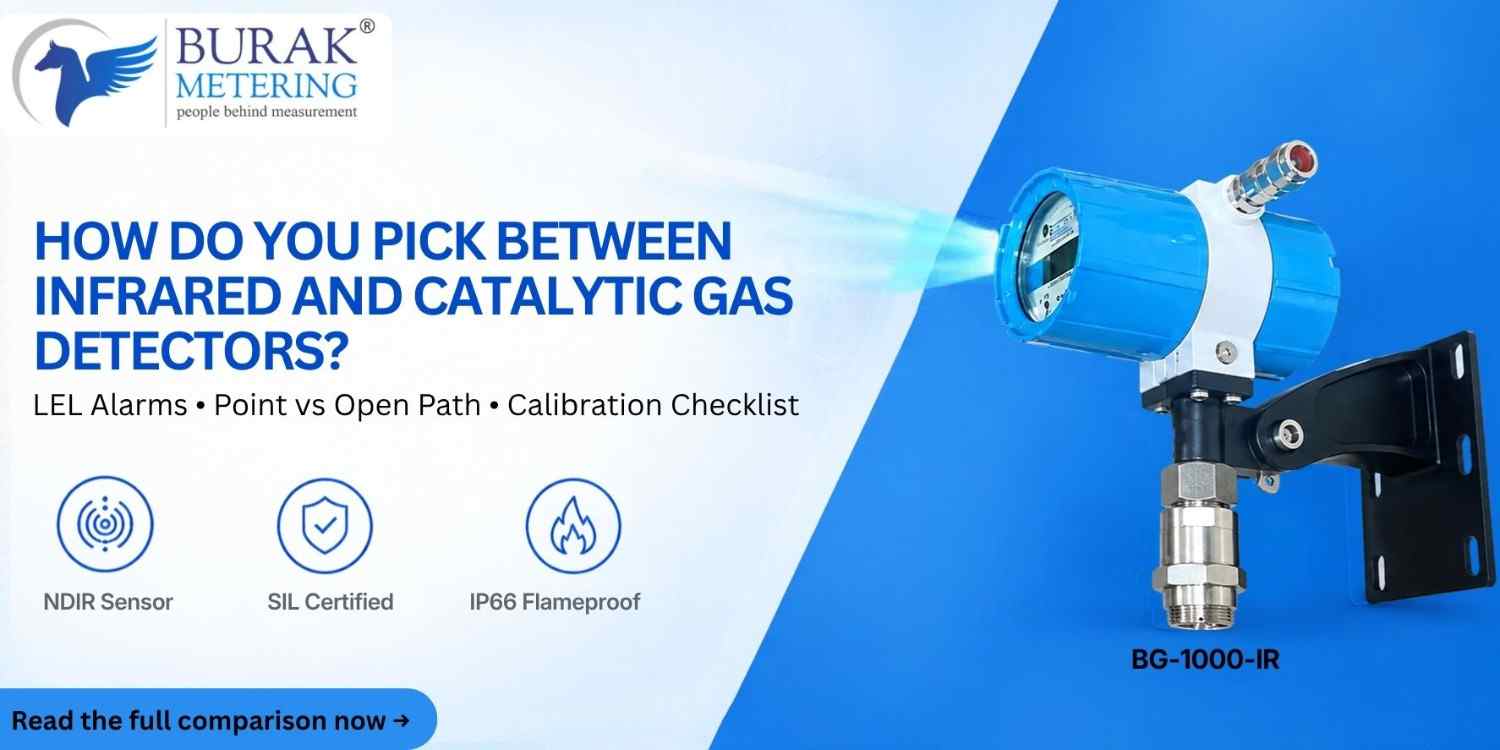
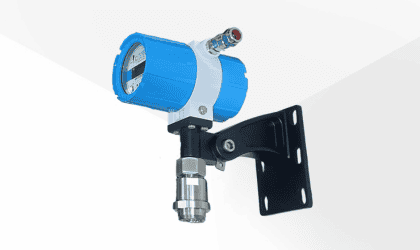
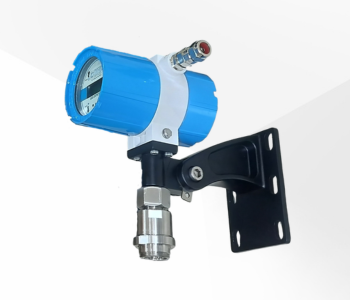
The Burak BG-1000-IR is a hydrocarbon infrared gas detector with a SIL certified infrared sensor. It shows gas level and status on an OLED display and supports 4-20 mA, RS485 Modbus, and alarm outputs.
FAQs
1. How does an IR gas detector differ from an NDIR gas detector?
The latter is the most popular type of IR gas detector and uses a fixed filter and reference beam.
2. Can an infrared gas detector detect hydrogen?
No, hydrogen does not absorb infrared light, so you need a different sensor.
3. What is the wavelength of the infrared hydrocarbon gas detector?
It is about 3.3 - 3.4 micrometers and corresponds to the carbon-hydrogen bond infrared absorption range.
4. Does an infrared gas detector operate without oxygen?
Yes, since it detects light absorption and not burning of the gas.
5. Are infrared sensors susceptible to poisoning as catalytic bead sensors?
No, they don't have a catalyst; thus, silicon and sulfur cannot poison them.
6. How often should a fixed gas detector be calibrated?
Refer to the manufacturer's manual, but there is one recommendation saying that an accuracy check should be done every 4-6 months and calibration at least once per year.
Looking for the Best Detector?
Tell us about your requirements, and we’ll suggest the most appropriate IR gas detectors for you. Quote request or call us at +91 9773141989
Share this post


I’m Saeed Lanjekar, founder of Burak Metering. With a background in engineering and technology, I’ve dedicated my career to creating advanced metering solutions that push the boundaries of accuracy and efficiency. At Burak Metering, we’re committed to delivering top-notch technology and driving innovation in the metering industry.
Products
Models
Related Blogs




 Email
 WhatsApp
 Phone
Newsletter
Subscribe to our newsletter for updates!

