- Feedback
- About
- Certificates
- Clientele
- Installations
- Testimonials
- Contact
- Career
- Get Quote


Flow Meter Calibration Guide 2026: ISO 17025, NABL & On-Site Methods

Saeed Lanjekar
30 Sep, 2026
7 Minutes
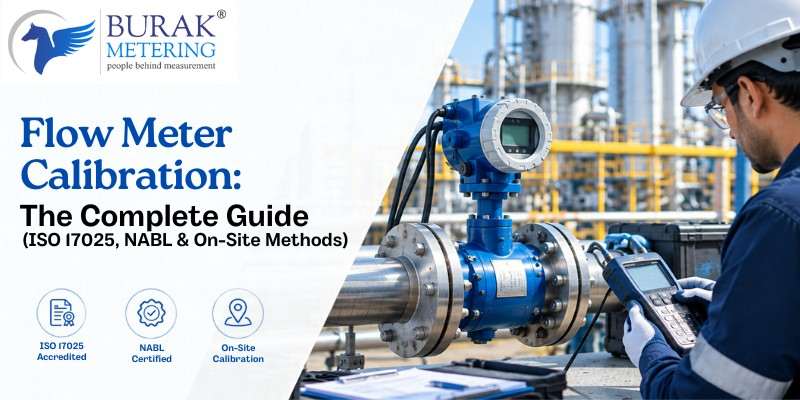
A deviation of as little as 1% in your flow meter readings means you are losing profit. This is simple arithmetic when you consider billing and custody transfer calculations. This booklet will help you understand everything about flow meter calibration, including its frequency, calibration methods based on the flow meters you have, and the true benefit of ISO 17025 and NABL accreditations.
What Is Flow Meter Calibration, Exactly?
Calibrating a flow meter involves comparing readings from your meter against a reference standard flow measurement to rectify drift. The exercise is essentially an accuracy report that has documentation to prove your flow meter's performance.
In the electronic era, all flow meters eventually start drifting due to coatings on the sensors as well as wear and tear on the bearings. Calibration helps to prevent such drift from becoming a problem.
The exercise involves three simple steps. You pass the flow through the meter, you take readings, and then you compare those readings against the reference measurements. Finally, you document any deviations that might exist. The exercise is done by a laboratory accredited to the NABL/ISO 17025 that traces the reference measurement to a national metrology institute.
Why Does Flow Meter Calibration Matter So Much?
Given that drift uncorrected is not just an 'imprecise' measurement but leads to actual loss in financial and safety terms, a 1–2% drift error in a high-volume flow can easily translate into lakhs or crores lost every year in material losses or billing problems.
Here is a calibration test: the moderate-sized electromagnetic flow meter that measures 800 cubic meters per hour of raw water, even at just 1% drift, loses track of tens of thousands of cubic meters a year, from one meter in just one year at one small percent point.
It's not all about finances. The wrong flow measurement could be misleading in the pharmaceutical industry, the chemicals, and power generation operations, where it could cause an error in dosing, ratio mixing, or even in reactor cooling, where accuracy is a requirement in safety considerations.
Additionally worth mentioning, as per the predictions, the total worth of the global flow meter industry is anticipated to be between 11 and 13 billion US dollars by 2025, and the growth rate will be between 5% and 8% per year up until the 2030s.
What Is ISO 17025, and What Makes It So Important?
ISO/IEC 17025 is the international standard specifying the technical competence and reliability of a testing or calibration laboratory. The absence of mention of this standard in a lab's certificate should be regarded as an indication of trouble.
The document is issued by ISO and IEC and sets forth the criteria of the laboratory's competence, impartiality, and consistency, allowing the consumers to have a unified criterion of confidence.
Accreditation in practice is equivalent to reference equipment traceability to national standards, competency check-ups of laboratory personnel, and providing each report with the statement of measurement uncertainty. Accredited flow labs operate all over the world, including UK ones accredited by UKAS and international labs providing both bench and on-site calibration.
What Is NABL Accreditation, and How Is It Different in India?
NABL is the national Indian authority that accredits laboratories in line with the requirements of ISO 17025, the local accreditation mark recognized by international auditors. In India, NABL certification is required, not optional, for any regulatory and export use.
NABL stands for National Accreditation Board for Testing and Calibration Laboratories operating in India through its Quality Council of India. It is third-party evidence of the fact that a laboratory actually meets all the requirements of ISO/IEC 17025:2017 and not just claims so.
This is the point people overlook: NABL is not a "watered-down" version of ISO 17025, but the Indian procedure for carrying out this international standard, including local audits and recertification. The NABL status of any laboratory may be verified online through the NABL website using its certificate number.
Since NABL accreditation is internationally accepted through the ILAC Mutual Recognition Arrangement, an NABL certificate of a laboratory located at Ahmedabad or Hyderabad would be equally important for export purposes as well. The manufacturing zones near Ahmedabad make extensive use of NABL flow calibration because even one percent error in the daily flow of raw materials can amount to crores of rupees every year.
What Are the Main Flow Meter Calibration Methods?
There are three general types of calibration: laboratory (bench), on-site (in-line), and master-meter comparison calibration. They differ in terms of trade-offs between accuracy, cost, and downtime.
Gravimetric (weighing) calibration: Fluid flows through a pipe into a tank and is measured in a known period of time by using a calibrated scale. This method can be considered a primary reference method because its results are directly linked to mass measurement.
Volumetric or master-meter calibration: a master meter that is already calibrated and traceable is placed in series with the meter that requires calibration.
In-line or on-site calibration: the meter stays in place; a calibrated reference device is connected, usually a portable ultrasonic meter.
The choice of proper method depends on the size of the meter, the fluid, and the possibility to stop the flow. The latter point is important, particularly in the case of large pipes when large and hard-to-replace electromagnetic meters are used.
What's the Right Frequency for Electromagnetic Flow Meters?
For industrial applications, a frequency of one year is usually taken as the standard; however, difficult environmental conditions require shorter periods, whereas clean, stable applications might stretch it. There's no one figure that will suit all plants.
For most applications and most manufacturers, annual calibration is recommended for electromagnetic flow meters; it is a decent starting point when you lack previous experience with performance.
Adjust your schedule based on specific conditions:
- Standard and clean service: every 12-24 months, depending on the usage and requirements.
- Harsh or chemically aggressive environment: every six months if the process requires accurate readings.
- Extreme environment or continuous high load: sometimes up to every three months.
- Immediately after installation, repairs, or a change in fluid type.
Electromagnetic flow meters have no moving parts; that is why, together with ultrasonic and Coriolis ones, they are more durable and withstand longer periods; their drifting is mostly electronic, not mechanical. Meters with moving parts such as turbines and positive-displacement ones degrade physically and require frequent calibrations.
The best long-term solution is not a scheduled date but a trend one. There was an instance where drift in the turbine meter increased steadily through several fixed periods of two years; when this trend was considered and a schedule of six months was used instead, batch quality increased while material waste was reduced.
How Often Should You Calibrate a Turbine Gas Meter?
Turbine gas meters require more care than electromagnetic flowmeters since they have rotating parts that physically wear out. In harsh environments, this may translate to calibration every three to six months instead of once a year.
Turbine meters using bearings in slurries containing abrasives or in dirty gas streams may require calibration every three to six months, becoming even shorter if operating continuously above about 80% of their maximum rated capacity, if there is a history of drift, or in viscous fluids.
Turbine gas meters operate under well-defined standards: OIML R 32 standardizes general requirements for rotary-piston and turbine gas meters, while AGA Report No. 7, published by the American Gas Association, covers the measurement of natural gas through turbine meters. If you are in the oil and gas industry, you will be familiar with AGA-7.
Pressure becomes important beyond what people think. OIML and the European standard EN 12261 indicate that calibration at field pressure is needed once the pressure exceeds 4 bar (60 psig). Calibration at atmospheric pressure suffices below this threshold. But above this threshold, one should calibrate the meter at field pressure to eliminate an embedded error.
Begin with guidance from the manufacturers and AGA-7/OIML R32 specifications, and narrow down the interval for dirtier gases, near-maximum flows, and drift problems identified through the "as found" tests.
How Is Mass Flow Meter Calibration Different?
While mass flowmeters, usually of Coriolis type, directly measure mass without inferring from volume and therefore have inherent stability, there is still a need for regular verification, as the sensing tubes themselves could deteriorate after prolonged periods of operation.
Unlike electromagnetic or turbine meters, Coriolis flowmeters do not depend on the extra step of volume to mass conversion, as the vibrating tubes directly measure mass flow. This is one of the reasons why Coriolis meters are preferred for custody transfer.
Annual verification is required in any case because the vibrating tubes constitute the sensor part of the system, and wear or formation of coatings inside can affect the calibration. Robustness does not mean lack of maintenance requirements.
Standards are tightening in this field too. As early as 2025, one prominent manufacturer presented the Coriolis meter that received the metrology certification as custody transfer accurate in liquid hydrogen service.
How Do You Choose the Right Method and Interval?
Match the method with your meter type and risk level, then adjust the calibration schedule using actual drift data.
- Determine your meter type. No moving parts meters (electromagnetic, ultrasonic, or Coriolis) can tolerate more time than mechanical meters (turbine, positive displacement).
- Determine your fluids and environment. Corrosive, abrasive, hot, or high-viscosity fluids call for shorter intervals.
- Check your regulations. Custody transfer, energy audits, and exports from India generally require NABL or ISO 17025 accreditation.
- Start with your meter manufacturer’s baseline, and use on-site data from two or more cycles to determine if you should lengthen or shorten it.
- Decide between in-lab vs. on-site calibration based on meter size, downtime ability, and if the fluid can be diverted without danger.
That’s basically how the certified calibration labs and meter manufacturers already recommend that you set up a program.
Frequently Asked Questions
Can I calibrate a flow meter without removing it from the pipeline?
Often, yes, on-site calibration with portable master meters or clamp-on ultrasonic units avoids downtime on large lines.
Do new flow meters need calibration before first use?
Yes, factory calibration should be verified on-site once installed, since transport, mounting, and pipe conditions can shift accuracy.
Which flow meter type needs the most frequent calibration?
Turbine and other mechanical meters need it most often, since moving parts wear faster than the electronics in magnetic or Coriolis meters.
What would be the consequences if I avoid calibration of the flow meter?
The error due to drift builds up continuously without being detected until some audit makes you realize it.
Does higher cost calibration mean higher accuracy?
No, traceability and recorded uncertainty have much greater importance than the cost mentioned in the invoice.
Can I calibrate the flow meter in-house without sending it to a laboratory?
While you can do basic testing using another flow meter as a comparison device, to have a valid report, you would have to send your flow meter out to a lab certified by NABL or ISO 17025.
What is the difference between calibration and verification?
In calibration, you compare the reading of the meter to a traceable standard and record it in your notes. Verification is similar in that you verify that the flow meter is operating within the acceptable tolerance but not necessarily provide an uncertainty statement.
Need your flow meters calibrated the right way with real ISO 17025 and NABL traceability, not just a certificate for the file? Talk to Burak's calibration team and get it done properly the first time.
Share this post


I’m Saeed Lanjekar, founder of Burak Metering. With a background in engineering and technology, I’ve dedicated my career to creating advanced metering solutions that push the boundaries of accuracy and efficiency. At Burak Metering, we’re committed to delivering top-notch technology and driving innovation in the metering industry.
Products
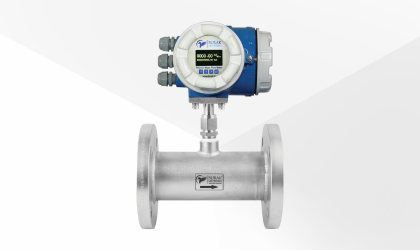
Thermal Mass Flow Meter
Thermal Mass Flow Meter
A thermal mass flow meter is a specialized instrument used to measure the flow rate of gases. It operates by heating a sensor in the fluid's path and…
Learn More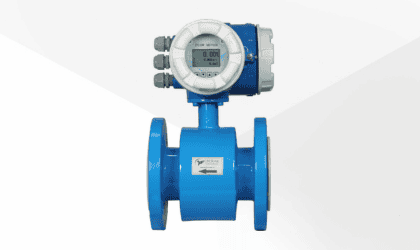
Electromagnetic Flowmeter Manufacturer in India
Electromagnetic Flowmeter Manufacturer in India
Burak Metering is a leading electromagnetic flow meter manufacturer in India, offering precision, reliability, and custom-engineered mag flow measure…
Learn More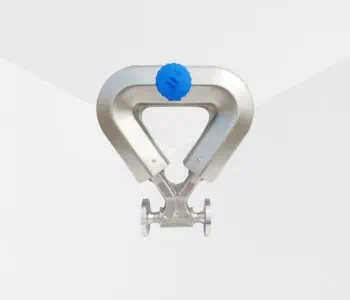
Coriolis Mass Flow Meter
Coriolis Mass Flow Meter
A Coriolis mass flow meter is a highly accurate instrument used to measure the mass flow rate of fluids, including liquids, gases, and slurries. It w…
Learn More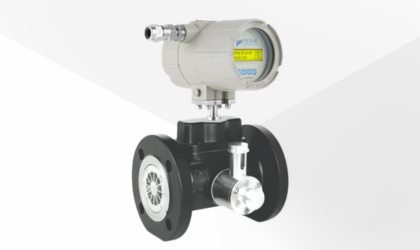
Turbine Gas Meter Manufacturer in India
Turbine Gas Meter Manufacturer in India
As a leading Turbine Gas Meter Manufacturer in India, Burak Metering delivers a highly efficient and accurate solution for gas flow measurement acros…
Learn MoreRelated Blogs

 Email
Email
 WhatsApp
 Phone
Phone
Newsletter
Subscribe to our newsletter for updates!