- Feedback
- About
- Certificates
- Clientele
- Installations
- Testimonials
- Contact
- Career
- Get Quote


Coriolis Mass Flow Meter: The Definitive Guide to Accuracy, Density & Multi-Variable Measurement

Saeed Lanjekar
06 Oct, 2026
5 Minutes
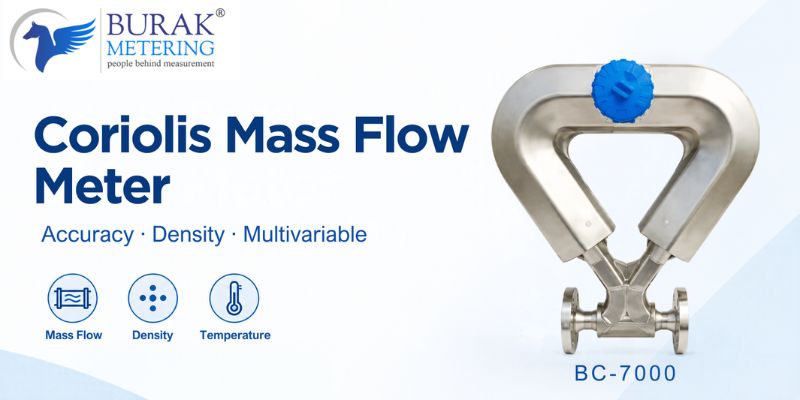
If you need one instrument that gives you mass flow, density, and temperature with almost zero maintenance and accuracy, other flow meters just can't touch a Coriolis mass flow meter, probably. It's not hype. It's physics doing the heavy lifting.
Let's break down why plants across pharma, oil & gas, and chemicals keep choosing this over every other flow technology.
What Is a Coriolis Mass Flow Meter?
The Coriolis flow meter is a direct mass flow measuring device that works on the principle of a minute twisting motion of a vibrating tube resulting from flowing fluid. This is not an indirect measurement at all.
That's the big difference from a Coriolis flowmeter's older cousins:
- Volumetric meters (turbine, vortex) measure volume, then someone has to convert it to mass using density.
- Coriolis flow sensors skip that step entirely.
Less math, fewer error sources. Simple as that.
How does a vibrating tube actually measure mass flow? Learn more about Coriolis flow meters
How Does a Coriolis Flow Transmitter Actually Work?
Short version: fluid flows through a vibrating tube, and the vibration twists slightly. That twist is proportional to mass flow, read it, and you have your answer.
Here's the slightly longer, still-simple version:
- One or two tubes are vibrated at their natural resonant frequency by an electromagnetic actuator.
- With zero flow, the tube vibrates symmetrically, with no twist.
- Once fluid moves through, the Coriolis effect creates a phase shift between the inlet and outlet sides of the tube.
- That phase shift is directly proportional to mass flow rate, as fluid moving through a vibrating tube generates a force that twists the tube in proportion to mass flow.
No straight pipe runs are needed before or after the meter, either a genuine installation win for tight skids.
How Accurate Is a Coriolis Flow Meter, Really?
Coriolis measuring devices lead in accuracy rankings for flow meters. The accuracy of most is 0.1% to 0.5% of reading, while some of the low-flow laboratory models are quoted as ±0.6% of reading.
Here's what the numbers typically look like:
Older field data put general Coriolis accuracy around 0.1% of reading over a 20:1 turndown, still excellent by any industrial standard.
One honest caveat (because trust matters more than a sales pitch): performance can dip with high gas content in liquid streams, though modern designs have narrowed that gap significantly.
Can It Really Measure Density and Temperature Too?
Yes, and this is where the "multivariable Coriolis flow meter" earns its name. One sensor. Four readings. No separate density meter, no separate thermometer.
A single Coriolis mass flow transmitter typically reports:
- Mass flow - the primary measurement, direct and unconverted
- Volumetric flow - mass flow divided by measured density, no extra hardware
- Density - from the tube's own resonant frequency, which shifts with fluid density
- Temperature - used internally for compensation and available as an output
Coriolis mass flow meters and controllers can measure and control true mass flow at accuracy levels well into the sub-1% range, and pairing that with live density is exactly why blending, batching, and custody-transfer teams love this instrument.
Why Does "Multivariable" Matter for Your Process?
Because one Coriolis density meter reading can replace three separate instruments and three separate calibration schedules.
Practical wins this unlocks:
- Concentration monitoring - combining density with mass flow enables inferred concentration readings, such as percent solids in a slurry or alcohol content in a blend
- Custody transfer - one certified device instead of a chain of instruments that all need to agree
- Fewer failure points - less wiring, less calibration drift, less to troubleshoot at 2 a.m.
If your process involves blending, dosing, or trade handover, a mass flow measurement system built around Coriolis tech genuinely simplifies life.
Where Do Coriolis Flow Sensors Actually Get Used?
Everywhere accuracy and reliability matter more than upfront cost. That's oil & gas, chemicals, food & beverage, and pharma, mostly.
Common real-world applications:
- Custody transfer of crude oil, LNG, and LPG
- Chemical dosing and injection where even 0.5% error costs money
- Pharma batching, where regulatory audits demand traceable accuracy
- Compressed gas and industrial gas flow measurement (nitrogen, argon, biogas)
- Hydrogen dispensing, flagged by industry analysts as the fastest-growing gas application for Coriolis meters going forward
Fun fact for the skeptics: this isn't a niche instrument anymore. The Coriolis flowmeter market was $1.9 billion in 2024 and is projected to exceed $2.4 billion by 2029, growing at roughly 6.2% CAGR. That's not a technology fading out. It's one actively taking a share from older meter types.
Coriolis vs Other Mass Flow Meters: What's the Real Difference?
The short answer: Coriolis measures mass directly; almost everything else measures something else and calculates mass afterward.
A quick, honest comparison:
- Thermal mass flow meters, great for gas, but sensitive to gas composition changes
- Vortex flow meters are a good general-purpose choice, but needs some straight pipe run
- Coriolis flow meter, no straight-run requirement, handles liquids and gases, and throws in density and temperature for free
That said, Coriolis meters aren't magic. They cost more upfront, add some pressure drop from the tube geometry, and get pricier as line size grows. Worth knowing before you commit.
How Do You Pick the Right Mass Flow Meter Manufacturer?
Match the application first, then the certifications, then the manufacturer's track record in that order.
A quick checklist before you request quotes:
- Confirm the line size range fits your pipeline (Coriolis units generally run DN1 to DN300+)
- Check for hazardous area approvals (ATEX) if your site needs them
- Ask about custody transfer certification (OIML/API) if billing depends on the reading
- Compare the turndown ratio against your actual flow variation, not just peak flow
- Request real accuracy specs in writing, not just "highly accurate" marketing language
A reliable mass flow meter supplier will walk you through tube material options too, since the correct tube material lets the meter work at elevated temperatures above 200°C, and newer builds use stronger, lighter materials like titanium and super duplex for better durability and corrosion resistance.
FAQs
1. What is a Coriolis mass flow meter used for?
It's used to directly measure mass flow, density, and temperature of liquids and gases in one device.
2. How accurate is a Coriolis flow meter?
Typical accuracy runs 0.1% to 0.5% of reading, among the best of any flow technology.
3. Can a Coriolis flow meter measure gas flow?
Yes, a Coriolis gas flow meter works well, though gas accuracy is usually slightly lower than for liquids.
4. Does a Coriolis mass flow meter need straight pipe runs?
No, which is a major reason it's preferred on tight, congested piping skids.
5. What's the difference between mass flow and volumetric flow?
Mass flow stays constant regardless of pressure or temperature; volumetric flow changes as fluid density changes.
6. Who invented the Coriolis flow meter?
Micro Motion first introduced the Coriolis flowmeter commercially in 1977.
7. Is a Coriolis Meter Different from a Multivariable Coriolis Meter?
No, they're the same thing. "Multivariable" just means one Coriolis meter measures mass flow, density, and temperature together.
What if one meter could replace three instruments in your plant? Let's find out together.
Share this post


I’m Saeed Lanjekar, founder of Burak Metering. With a background in engineering and technology, I’ve dedicated my career to creating advanced metering solutions that push the boundaries of accuracy and efficiency. At Burak Metering, we’re committed to delivering top-notch technology and driving innovation in the metering industry.
Products
Related Blogs

 Email
Email
 WhatsApp
 Phone
Phone
Newsletter
Subscribe to our newsletter for updates!