Working Principle of Multivariable Transmitter
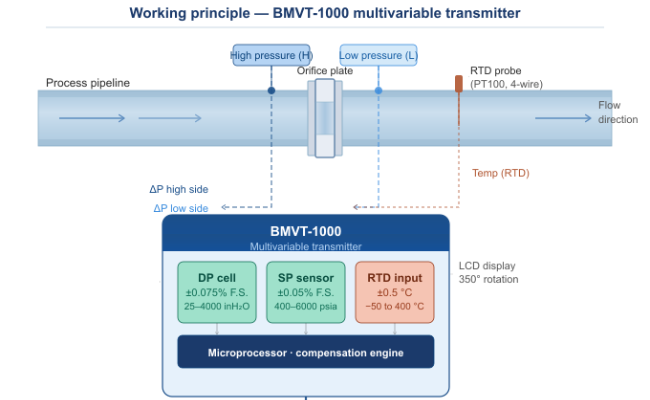
The BMVT-1000 operates on the differential pressure measurement principle combined with real-time static pressure and temperature sensing to deliver fully compensated flow measurement from a single instrument. Understanding how each measurement variable is acquired — and how they are combined — is key to appreciating the accuracy and reliability the BMVT-1000 brings to flow measurement applications.
Differential Pressure (DP) Measurement: A differential pressure primary element (orifice plate, venturi, flow nozzle, or cone meter) installed in the pipeline creates a pressure difference between the upstream (high-pressure) and downstream (low-pressure) tapping points. This differential pressure is proportional to the square of the fluid velocity. The BMVT-1000 senses this DP across its high-stability piezoresistive capsule with accurate filling fluid technology, which eliminates errors caused by ambient temperature variation and line static pressure — two major sources of inaccuracy in standard DP transmitters.
Flow Rate Calculation: The fluid velocity derived from the DP measurement is combined with the known cross-sectional area of the pipe and the geometry coefficient of the primary element to calculate volumetric flow rate. Using the simultaneously measured static pressure and process temperature, the BMVT-1000 output is transmitted to a flow computer, which calculates corrected mass flow or standard volumetric flow in real time.
Static Pressure Measurement: The BMVT-1000 measures absolute static pressure on the high-pressure side of the DP element. Real-time static pressure data is essential for calculating the actual gas density and, in combination with the AGA8 or similar equation of state, the gas compressibility factor (Z). This ensures that flow calculations remain accurate even when line pressure varies significantly from design conditions.
Temperature Measurement: Process temperature is measured via an external PT100 ohm RTD sensor (4-wire connection) inserted into the pipeline through a thermowell, close to the primary flow element. Accurate process temperature is required for gas density and compressibility calculations and for converting actual volumetric flow to standard conditions (Nm³/hr, Sm³/hr, kg/hr).